




A fertility clinic is a specialized medical center that helps individuals and couples diagnose and treat problems related to infertility, pregnancy planning, and reproductive health. These clinics offer advanced medical technology, expert care, and personalized treatment to improve the chances of conceiving.
Table of Contents
“Fertility Clinic” Explained
A fertility clinic represents a specialised hospital specialising in assisting single people or couples that are having difficulty conceiving. These are modern clinics offering infertility therapies, which are manned by a multidisciplinary group of reproductive endocrinologists, embryologists, andrologists, reproductive surgeons, and other doctors. Fertility clinics by treating various reproductive health ailments hope to assist individuals achieve their wish of parenting by their experience and modern technologies.
Process of Visiting a Fertility Clinic
Here is a clear step-by-step table explaining what usually happens when you visit a fertility clinic for the first time and during treatment.
| Step | Process | What Happens | Purpose |
| 1 | Appointment Booking | Contact the clinic by phone or online to schedule a consultation. | Helps plan your visit and prepare medical details. |
| 2 | Initial Consultation | Meet a fertility specialist such as a doctor from Apollo Fertility or Nova IVF Fertility. The doctor asks about your medical history, lifestyle, and previous treatments. | Understand your fertility concerns and background. |
| 3 | Medical History Review | Includes menstrual cycle details, pregnancy history, sexual health, and family health conditions. | Identifies possible fertility issues early. |
| 4 | Physical Examination | Basic health check for both partners, including reproductive health assessment. | Detects visible or physical causes. |
| 5 | Diagnostic Tests | Blood tests, hormone tests, ultrasound, semen analysis, and other screenings. | Finds the exact cause of infertility. |
| 6 | Diagnosis & Discussion | The specialist explains test results and possible fertility problems. | Helps you understand your condition. |
| 7 | Treatment Plan | Personalized plan may include medications, lifestyle changes, or advanced options. | Provides a structured path for treatment. |
| 8 | Treatment Options | Common methods include In vitro fertilisation (IVF), Intrauterine insemination (IUI), ovulation induction, or surgery. | Improves chances of pregnancy. |
| 9 | Counseling & Emotional Support | Many clinics offer mental health counseling and support groups. | Reduces stress and improves emotional well-being. |
| 10 | Follow-up & Monitoring | Regular check-ups, scans, and progress tracking during treatment. | Ensures treatment success and safety. |
Benefits of Visiting a Fertility Clinic
Visiting a fertility clinic can provide expert guidance, advanced treatment options, and emotional support for individuals or couples facing difficulty in conceiving. Here are the major benefits explained clearly.
1. Early Diagnosis of Fertility Issues
Fertility specialists help identify the root causes of infertility in both men and women through medical history, tests, and screenings. Clinics such as Apollo Fertility and Nova IVF Fertility use modern diagnostic tools to detect problems early.
Benefit:
Early detection increases the chances of successful treatment.
2. Access to Expert Specialists
Fertility clinics have experienced gynecologists, andrologists, and reproductive endocrinologists who focus only on reproductive health.
Benefit:
You receive accurate advice and specialized care rather than general treatment.
3. Personalized Treatment Plans
Every couple has unique health conditions. Fertility experts design customized treatment based on:
- Age
- Hormone levels
- Medical history
- Lifestyle factors
Benefit:
Improves success rates and saves time.
4. Advanced Fertility Treatments
Clinics offer modern options such as:
- Ovulation induction
- IUI (Intrauterine insemination)
- IVF (In vitro fertilisation)
- Egg and sperm freezing
Benefit:
Provides multiple solutions based on your needs.
5. Better Chances of Pregnancy
With the right diagnosis and treatment, fertility clinics significantly increase the chances of conception compared to self-treatment.
Benefit:
Higher success rates through monitored and scientific methods.
6. Emotional and Psychological Support
Infertility can be stressful and emotionally challenging. Fertility clinics provide counseling and support programs.
Benefit:
Reduces anxiety and helps couples cope with emotional pressure.
7. Lifestyle and Health Guidance
Specialists recommend:
- Diet and nutrition
- Exercise
- Stress management
- Weight control
Benefit:
Improves reproductive health naturally.
8. Continuous Monitoring and Care
Regular check-ups, hormone monitoring, and ultrasound scans ensure that treatment is progressing correctly.
Benefit:
Reduces complications and improves outcomes.
9. Safe and Ethical Treatment
Reputed fertility clinics follow medical guidelines, confidentiality, and ethical practices.
Benefit:
Ensures patient safety and transparency.
10. Awareness and Education
Patients learn about reproductive health, fertility windows, and healthy pregnancy planning.
Benefit:
Helps couples make informed decisions about family planning.
When to Visit a Fertility Clinic
When you have been attempting to conceive naturally more than one year with no result or more than six months when you are older than 35, then you may need to find assistance of a fertility laboratory. Additional signs that may require the services of a fertility clinic will be irregular periods, known or suspected fertility problems, a miscarriage history, or a male partner who has known or suspected fertility problems.
Along the path of fertility, one will meet difficult times. However, one should not forget that seek-ho assistance is never a weakness but a step towards a solution. A quality fertility clinic must offer a friendly and supportive atmosphere that includes a helpful staff to assist you in your fertility process. And even though the parenthood journey might be a journey to hell in some cases, it is worth remembering that seeing a fertility clinic, such as First Fertility IVF, may be the first step to realizing your family dreams.
Some people may also have questions about contraception and pregnancy planning while discussing their reproductive health. Understanding i-Pill tablet uses can provide general information about emergency contraception, although it is separate from fertility treatment and should not be confused with infertility care.
Causes of Infertility Treated at a Fertility Clinic

Female Infertility Causes
- Polycystic Ovary Syndrome (PCOS)
- Endometriosis
- Blocked fallopian tubes
- Diminished ovarian reserve
- Uterine fibroids
- Irregular ovulation
- Hormonal imbalance
- Premature ovarian insufficiency
Reproductive health concerns can sometimes overlap with questions about vaginal infections and related treatments. For general information, you can also read about ovules for infections, although infection treatment should be based on an appropriate medical diagnosis rather than self-treatment.
Male Infertility Causes
- Low sperm count
- Poor sperm motility
- Abnormal sperm morphology
- Varicocele
- Erectile dysfunction
- Hormonal imbalance
- Genetic conditions
Unexplained Infertility
About 10–20% of couples may have no clear diagnosis after testing.
Types of Treatments Offered in a Fertility Clinic
- Ovulation Induction
Medications stimulate egg production.
Common drugs:
- Clomiphene citrate
- Letrozole
- Gonadotropins
Best for: PCOS, irregular ovulation
- Intrauterine Insemination (IUI)
Sperm is directly placed into the uterus during ovulation.
Best for:
- Mild male factor infertility
- Cervical issues
- Unexplained infertility
- In Vitro Fertilization (IVF)
Egg and sperm fertilized in lab, embryo transferred to uterus.
Best for:
- Blocked tubes
- Severe male infertility
- Endometriosis
- Failed IUI
- Intracytoplasmic Sperm Injection (ICSI)
A single sperm injected into egg during IVF.
Best for:
- Very low sperm count
- Poor motility
- Previous IVF failure
- Donor Programs
- Egg donor
- Sperm donor
- Embryo donation
- Surrogacy
A gestational carrier carries the pregnancy.
- Fertility Preservation
- Egg freezing
- Sperm freezing
- Embryo freezing
- Ovarian tissue freezing
Advanced Technologies Used in Fertility Clinics
- Time-lapse embryo monitoring
- Preimplantation Genetic Testing (PGT-A / PGT-M)
- Laser-assisted hatching
- Cryopreservation (vitrification)
- Artificial intelligence embryo selection
- ERA (Endometrial Receptivity Analysis)
Success Rates in Fertility Clinics
Success depends on:
- Age of woman
- Egg quality
- Sperm quality
- Clinic technology
- Underlying cause
- Lifestyle factors
Average IVF Success Rates (Global Estimate)
| Age Group | Success Per Cycle |
| Under 35 | 40–55% |
| 35–37 | 30–40% |
| 38–40 | 20–30% |
| 41–42 | 10–20% |
| 43+ | Below 10% |
Fertility Clinic Cost Breakdown (India & Global 2026)
India Pricing (Approximate)
| Treatment | Cost Range (INR) |
| Initial Consultation | ₹1,000 – ₹3,000 |
| Hormone Testing | ₹5,000 – ₹15,000 |
| Semen Analysis | ₹800 – ₹2,500 |
| IUI | ₹8,000 – ₹20,000 per cycle |
| IVF | ₹1,20,000 – ₹2,50,000 per cycle |
| IVF with ICSI | ₹1,50,000 – ₹3,00,000 |
| Egg Freezing | ₹1,00,000 – ₹1,80,000 |
| Embryo Freezing (Annual Storage) | ₹20,000 – ₹40,000 |
| Donor Egg IVF | ₹2,50,000 – ₹4,50,000 |
| Surrogacy | ₹10,00,000 – ₹18,00,000 |
Global Fertility Clinic Costs (Approximate)
| Country | IVF Cost (USD) |
| USA | $12,000 – $20,000 |
| UK | $5,000 – $9,000 |
| Australia | $6,000 – $10,000 |
| Canada | $8,000 – $15,000 |
| UAE | $7,000 – $12,000 |
| Thailand | $6,000 – $10,000 |
| India | $1,500 – $3,500 |
India is one of the most affordable fertility treatment destinations globally.
How to Choose the Best Fertility Clinic
- Check Success Rates
Ask for age-specific success rates.
- Doctor’s Experience
Board-certified reproductive endocrinologist preferred.
- Lab Quality
Embryology lab standards matter significantly.
- Transparency in Pricing
Avoid hidden costs.
- Technology & Equipment
Look for advanced IVF lab facilities.
- Emotional Support Services
Counselling availability is important.
Risks & Side Effects of Fertility Treatments
- Ovarian Hyperstimulation Syndrome (OHSS)
- Multiple pregnancy (twins/triplets)
- Ectopic pregnancy
- Emotional stress
- Financial strain
- Procedure complications (rare)
Emotional & Psychological Impact
Infertility can cause:
- Anxiety
- Depression
- Relationship strain
- Social isolation
Most advanced fertility clinics now provide:
- Psychological counselling
- Support groups
- Stress management programs
- Couple therapy
Lifestyle Factors That Improve Fertility
- Maintain healthy BMI
- Stop smoking
- Limit alcohol
- Regular moderate exercise
- Balanced diet
- Manage stress
- Sleep 7–8 hours
- Reduce caffeine intake
Legal Aspects of Fertility Treatment (India Focus)
India regulates ART clinics under:
- Assisted Reproductive Technology (Regulation) Act
- Surrogacy (Regulation) Act
Important points:
- Donor anonymity rules
- Age restrictions
- Surrogacy eligibility criteria
- Embryo storage limits
Fertility Tourism
India, Thailand, and Turkey are major fertility tourism hubs due to:
- Lower cost
- Skilled specialists
- High-quality labs
- English-speaking staff
Common Myths About Fertility Clinics
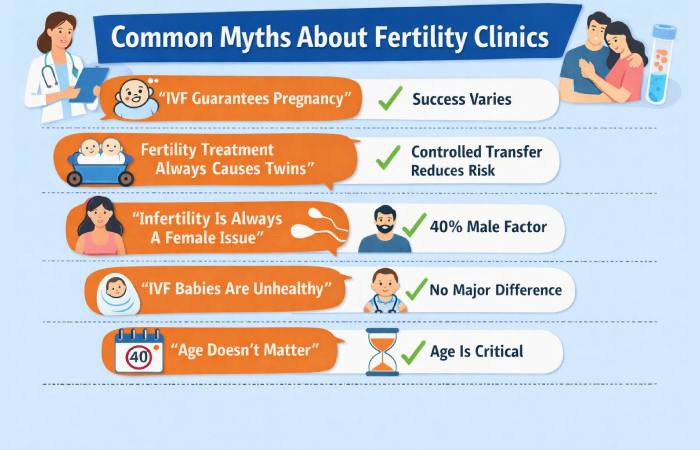
| Myth | Reality |
| IVF guarantees pregnancy | Success varies |
| Fertility treatment always causes twins | Controlled transfer reduces risk |
| Infertility is always female issue | 40% male factor |
| IVF babies are unhealthy | No major difference |
| Age doesn’t matter | Age is critical |
Timeline of a Typical IVF Cycle
- Ovarian stimulation (8–12 days)
- Egg retrieval
- Fertilization
- Embryo culture (3–5 days)
- Embryo transfer
- Pregnancy test (after 14 days)
Total: About 4–6 weeks
Red Flags to Avoid in a Fertility Clinic
- No transparent success data
- No written treatment plan
- Pressure for expensive add-ons
- Poor lab hygiene
- No counselling support
- Unrealistic promises
Frequently Asked Questions
How long should we try before visiting a fertility clinic?
- 12 months under age 35
- 6 months over age 35
Can stress alone cause infertility?
Stress affects hormones but rarely sole cause.
Is IVF painful?
Mild discomfort; egg retrieval under sedation.
How many IVF cycles are needed?
Average 2–3 cycles for many couples.
Future of Fertility Clinics (2026 Trends)
- AI embryo grading
- Genetic screening advances
- At-home fertility hormone testing kits
- Non-invasive embryo testing
- Stem cell fertility research
- Personalized reproductive medicine
Conclusion
A fertility clinic is not just a medical facility — it is a comprehensive reproductive care center that offers diagnosis, advanced treatment, emotional support, and hope.
From basic fertility testing to high-end assisted reproductive technologies like IVF and ICSI, fertility clinics provide structured and scientific solutions tailored to each patient’s unique reproductive profile.
While treatment costs, emotional stress, and medical procedures can seem overwhelming, modern fertility clinics have significantly improved success rates, safety standards, and patient support systems.
Seeking help from a fertility clinic is not a sign of failure — it is a proactive step toward building your family.
Saba Mirza is a Health, Wellness & Lifestyle Writer at Being Healthy Life with 3+ years of writing experience. She creates clear, informative, and reader-focused content covering health, wellness, nutrition, fitness, natural health, and lifestyle topics.
View Profile →
Sameena Begum is a health, technology, and digital content reviewer who reviews selected articles to help ensure that information is presented clearly, accurately, and responsibly.
View Profile →
Dr. Syed Imtiaz is a qualified medical professional with MBBS and MD qualifications and 5+ years of experience. As a Medical Reviewer at Being Healthy Life, he reviews selected health and wellness content for medical accuracy, clarity, appropriate context, and responsible presentation.
View Profile →