

Collagen has emerged as one of the most popular structural proteins to the preventive health, dermatology, orthopedics and nutraceutical science worlds. Collagen is the key biomechanical component of extracellular matrix of connective tissues since it contributes to skin elasticity, cartilage resistance, and other related functions.
This paper offers a scientifically based review of The Effects Of Collagen in the context of the key physiological systems such as dermal architecture, joint biomechanics, bone mineral density, muscle regeneration, gut permeability and hair follicle strength, as well as conclusions on cost comparisons of The Effects Of Collagen in the Indian supplement market.
Table of Contents
What Is Collagen?
Collagen is the widely occurring fiber protein in human body that makes about 30 percent of the total protein mass. It is the major structural framework of:
- Skin
- Tendons
- Ligaments
- Bones
- Blood vessels
- Cartilage
- Muscles
- Gastrointestinal lining
It is composed mainly of three amino acids:
| Amino Acid | Function in Collagen |
| Glycine | Structural stability |
| Proline | Tissue repair |
| Hydroxyproline | Elasticity & hydration |
The process of natural collagen synthesis decreases with age under the influence of oxidative stress, hormonal fluctuations and degradation of fibroblasts by UV radiation – the process begins to slow in the middle of the 20s.
Types Of Collagen And Their Physiological Effects
| Collagen Type | Found In | Primary Effect |
| Type I | Skin, bones, tendons | Skin elasticity & bone strength |
| Type II | Cartilage | Joint mobility |
| Type III | Muscles, arteries | Tissue regeneration |
| Type V | Hair & placenta | Cellular growth |
| Type X | Bone matrix | Skeletal development |
Supplementation with collagen peptides is widely used to:
- Improve dermal hydration
- Enhance tendon stiffness
- Support cartilage regeneration
- Increase bone mineral density
- Strengthen nail keratin
Regular intake is associated with improved skin elasticity and reduced wrinkle formation over time.
Effects Of Collagen On Skin Health
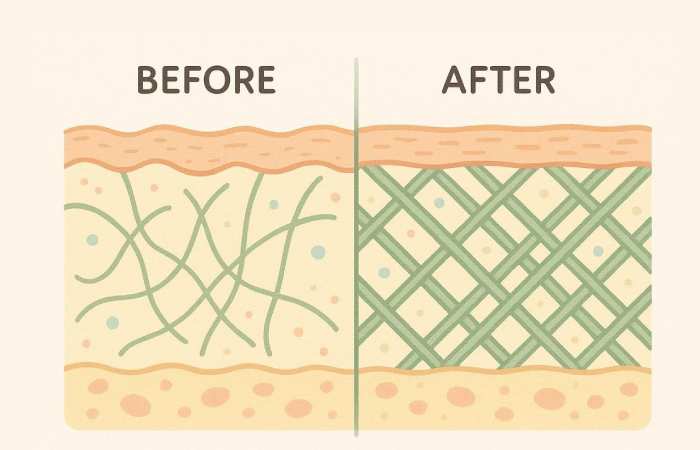
Collagen supports dermal fibroblast activity, allowing the skin to maintain:
- Tensile strength
- Moisture retention
- Elastic recoil
- Structural thickness
Dermatological Benefits
- Reduces fine lines and wrinkles
- Improves skin hydration
- Enhances barrier integrity
- Promotes wound healing
- Increases dermal density
Collagen peptides are frequently used to improve skin elasticity and hydration, contributing to a more youthful skin profile.
Effects Of Collagen On Joint & Bone Health
Type II collagen is predominantly located in articular cartilage, where it contributes to:
- Shock absorption
- Load distribution
- Joint lubrication
- Structural resilience
Musculoskeletal Benefits
- Reduces joint stiffness
- Supports cartilage repair
- Enhances mobility
- Improves bone strength
- May reduce osteoarthritis symptoms
Supplementation aids in maintaining cartilage integrity and can alleviate joint pain in degenerative conditions.
Effects Of Collagen On Hair & Nails
Collagen indirectly supports keratin production by supplying proline — a key precursor in hair shaft formation.
Observed Benefits
- Reduced nail brittleness
- Increased hair thickness
- Faster hair growth
- Stronger nail beds
Effects Of Collagen On Muscle Mass
Collagen contains essential amino acids that promote:
- Muscle tissue repair
- Post-exercise recovery
- Lean muscle development
It is frequently used by athletes to reduce soreness and improve muscular endurance following resistance training.
Effects Of Collagen On Gut Health
Collagen helps maintain epithelial integrity within the gastrointestinal tract by:
- Strengthening the intestinal lining
- Supporting mucosal repair
- Reducing gut permeability
This may assist individuals with inflammatory digestive conditions by improving barrier function. (WebMD)
Collagen Supplement Forms & Daily Dosage
| Form | Absorption Rate | Typical Dose |
| Powder | High | 5–10g daily |
| Tablets | Moderate | 2–4 tablets |
| Liquid | Fast | 15–25 ml |
| Gummies | Low-Moderate | 2–4 gummies |
Powdered collagen remains the most widely used format due to higher bioavailability and ease of mixing with beverages.
Price Comparison Of Collagen Supplements In India
Collagen Supplement Cost Analysis
| Type | Price Range (INR) |
| Basic Collagen Powder | ₹800 – ₹1,500 |
| Marine Collagen | ₹1,500 – ₹3,500 |
| Tablets/Capsules | ₹700 – ₹2,000 |
| Collagen Blends | ₹2,000 – ₹4,500 |
Marine collagen products are generally priced higher due to enhanced absorption and purity levels.
Cost Per Kg Based On Source
| Source | Price Per Kg |
| Animal-Based Collagen | ₹1,500 – ₹3,500 |
| Marine Collagen | ₹3,000 – ₹6,000 |
| Type I Collagen | ₹2,000 – ₹4,000 |
| Type II Collagen | ₹3,000 – ₹5,000 |
| Hydrolyzed Collagen | ₹2,500 – ₹5,000 |
High-purity collagen peptides (90%+) typically range from ₹3,000 to ₹6,000 per kg.
Estimated Functional Benefits Distribution (Pie Representation)
Collagen Usage in Health Applications:
- Skin Health – 35%
- Joint Support – 25%
- Hair & Nails – 15%
- Bone Health – 15%
- Gut Health – 10%
This reflects current consumer usage trends in nutraceutical supplementation. (Cleveland Clinic)
When Should You Start Taking Collagen?
The age over 25 years leads to a decrease in collagen production because of:
- Reduced fibroblast activity
- Hormonal fluctuations
- Oxidative stress of the environment
- Nutritional deficiencies
Prenatal supplementation can be used to protect stable connective tissue over the long-term.
Natural Sources Of Collagen
- Bone broth
- Fish skin
- Egg whites
- Citrus fruits (for synthesis support)
- Leafy greens
How Collagen Affects Hormonal Balance
Collagen has an indirect interaction with the endocrine health via its amino acid composition – especially glycine. Glycine has a regulatory action on cortisol regulation and could have an effect on sleep-wake rhythm by reducing core-body temperature and increasing the activity of the parasympathetic nervous system.
Key Hormonal Effects
- Supports adrenal function
- May reduce cortisol spikes
- Helps regulate insulin sensitivity
- Improves sleep quality through neurotransmitter balance
- Assists in estrogen metabolism
This becomes especially relevant in individuals experiencing hormonal fluctuations due to aging, menopause, or chronic stress exposure.
Collagen’s Role In Cardiovascular Health
Collagen helps in the structural integrity of the vascular tissues and arterial walls. It is a constituent of extracellular matrix in blood vessels, which enables arteries to be flexible and have tensile strength against the different hemodynamic pressures.
Cardiovascular Benefits
- Enhances arterial elasticity
- Supports endothelial lining
- Reduces arterial stiffness
- May lower LDL oxidation risk
- Improves circulation efficiency
A reduction in collagen synthesis over time can lead to vascular rigidity, increasing the risk of hypertension and atherosclerotic changes.
Effects Of Collagen On Metabolism
Collagen is a protein-based compound that is thermogenic and may facilitate metabolic effectiveness. It is commonly included in dietary regimens where one is restricted in the amount of carbohydrates and fat in foods they consume.
Metabolic Advantages
- Promotes satiety
- Supports lean muscle retention
- Enhances protein synthesis
- May reduce fat mass
- Helps maintain metabolic rate
Resistance training combined with collagen supplementation can be used to enhance the body composition by maintaining fat-free mass.
Collagen And Immune System Support
The collagen also has amino acids like arginine and glutamine that help in the proliferation of immune cells and regulation of inflammatory response.
Immune-Related Benefits
- Supports lymphocyte production
- Aids tissue repair post-infection
- Reduces systemic inflammation
- Improves wound healing
- Maintains mucosal defense barriers
This is particularly important for individuals recovering from injury or inflammatory conditions.
Bioavailability Of Hydrolyzed Collagen Peptides
Hydrolyzed collagen undergoes enzymatic breakdown into smaller peptide chains, improving gastrointestinal absorption and systemic bioavailability.
| Collagen Form | Molecular Size | Absorption Efficiency |
| Native Collagen | Large | Low |
| Gelatin | Medium | Moderate |
| Hydrolyzed Peptides | Small | High |
Smaller peptide structures are more readily absorbed through the intestinal epithelium, allowing improved distribution to dermal and musculoskeletal tissues.
Marine Collagen vs Bovine Collagen
| Feature | Marine Collagen | Bovine Collagen |
| Source | Fish Skin | Cow Hide |
| Absorption Rate | High | Moderate |
| Type | Type I | Type I & III |
| Price Range | Higher | Lower |
| Sustainability | Eco-friendly | Moderate |
Marine collagen is usually composed of smaller peptides, which can be beneficial to the penetration of the dermis and aid in anti-aging results.
Side Effects And Safety Considerations
Although collagen supplementation is considered as a harmless measure, overdosage can result in:
- Gastrointestinal discomfort
- Mild bloating
- Allergic reactions (marine sources)
- Hypercalcemia (rare)
- Interactions of drugs in some scenarios
Standardized dosage requirements are suggested in order to reduce adverse effects.
Collagen Supplement Market Growth In India
The Indian nutraceutical industry has witnessed a substantial rise in collagen-based product demand due to:
- Increasing skincare awareness
- Fitness industry expansion
- Aging population
- Preventive healthcare trends
Estimated Consumer Usage Growth
| Year | Estimated Users (Millions) |
| 2020 | 2.1 |
| 2022 | 3.8 |
| 2024 | 6.5 |
| 2026 | 9.2 |
This trend reflects growing consumer interest in structural protein supplementation for long-term health optimization.
Conclusion
Collagen is still a primary structural protein that is engaged in the preservation of connective tissue in a variety of physiological systems. Supplementation – especially in hydrolyzed peptide form has proven potentially to be useful in skin elasticity, joint mobility, bone density and muscle repair with regular use. Having a wide price range within India, the people have the option to choose the formulations depending on the therapeutic objectives, the levels of purity, and the type of collagen.