
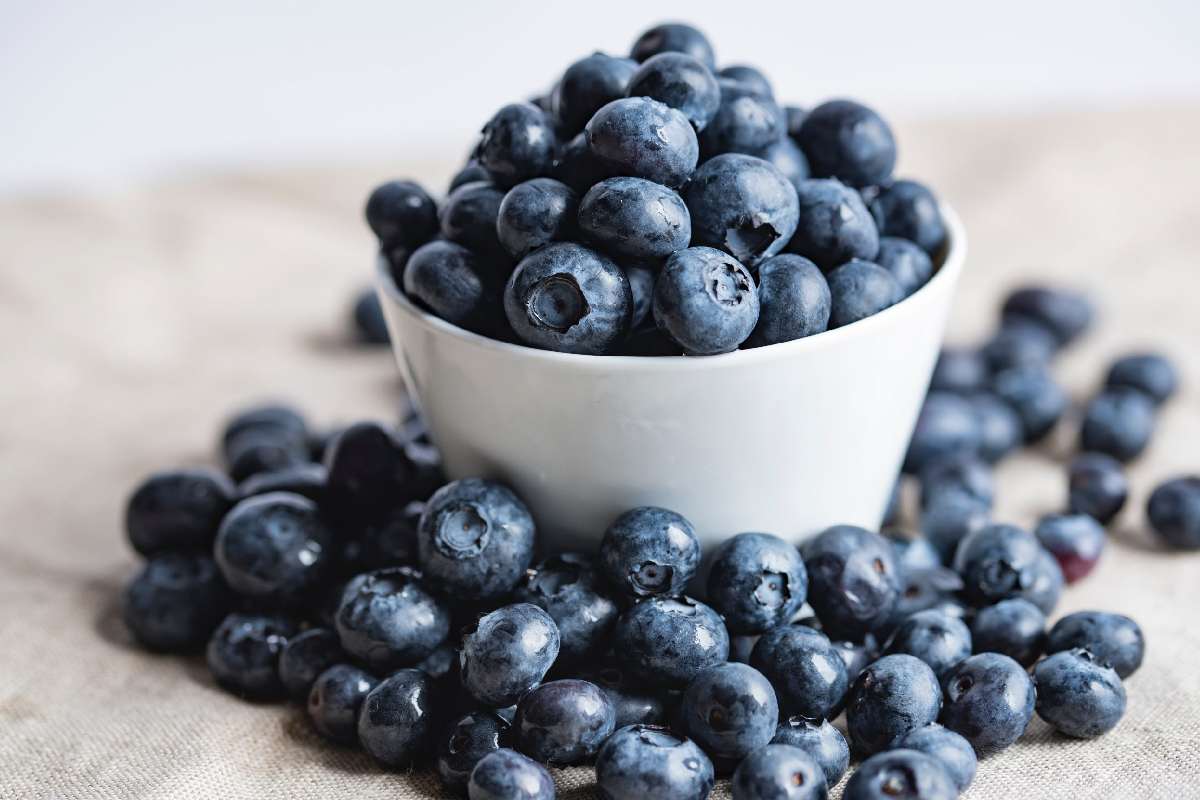
Whether you have ever asked yourself the question of whether the Blueberry is actual berry or you have ever wondered why they do not resemble the strawberries or the raspberries, you are on the right track. The response shows an interesting difference between botanical science and the common language.
The shocking fact here is as follows: Blueberries, botanically speaking, are actually true berries, unlike strawberries which are not berries. Such classification is not only an aspect of scientific trivia, but it is an indication of how blueberries grow, their morphology, and even nutritional value.
In this guide, you’ll discover exactly what kind of fruit the blueberry is, why it qualifies as a true berry, and how it compares to other fruits you might assume are berries. Let’s clear up the confusion once and for all.
Table of Contents
Quick Answer: Are Blueberries True Berries?
Yes, blueberries are true berries according to botanical classification.
Blueberries are members of the genus Vaccinium of the family Ericaceae (or heath family). They are grown out of one flower that possesses one ovary, the inside is fleshy, and there are several seeds that are within the flesh. This building is a perfect fit of the botanical definition of a berry.
What is interesting: fruits such as strawberries, raspberries and blackberries are not botanically berries even though they are named so. In the meantime, bananas, grapes, and tomatoes are actual berries. The fact that common names fail to correspond to the scientific classification is a general surprise to many people.
Moral of the Story: There is nothing like taste or cooking when botanists are classifying the fruits in terms of their structure and development. On such scientific standards, blueberries fit all the requirements to qualify as a real berry.
Understanding the Botanical Definition of a Berry
What Makes a Fruit a “True Berry”?
We refer to countless little round, juicy fruits that we eat in our daily speech as berries. The botanical definition of a berry however has a strict definition depending on the division of the fruit.
A true berry must meet these criteria:
- Breds with one flower (there are not several flowers or ovaries)
- One or more carpels (the female reproductive part), are found in the ovary.
- The whole wall of the ovary is softened (so-called pericarp).
- The fleshy fruit tissue has seeds embedded in them.
- May grow out of a better or worse ovary (location with respect to other parts of the flower)
Blueberries meet all five criteria
Blueberries meet all five criteria. One flower that has five petals produces the small, round fruit. The wall of the ovary is made ripe, and little seeds are scattered about the inside.
Knowing about the classification of fruits will answer the question as to why blueberries are berries but raspberries are not.
| Fruit Type | Definition / Characteristics | Examples |
| True Berry | Simple fruit from a single ovary; entire pericarp (fruit wall) is fleshy; seeds embedded inside. | Blueberry, Tomato, Grape, Kiwi |
| False Berry (Accessory Fruit) | Fruit develops from multiple parts of the flower, not just the ovary; fleshy. | Strawberry, Banana (technically), Pineapple (sometimes classified as multiple) |
| Aggregate Fruit | Forms from multiple ovaries of a single flower; each ovary develops into a small fruitlet, clustered together. | Raspberry, Blackberry, Strawberry (aggregate of tiny achenes) |
| Drupe (Stone Fruit) | Fleshy fruit with a single hard stone (seed) inside; develops from a single ovary. | Mango, Peach, Cherry, Olive |
| Multiple Fruit | Forms from the ovaries of multiple flowers that fuse together into a single mass. | Pineapple, Fig, Mulberry |
What Kind of Fruit is the Blueberry?
| Aspect | Details |
| Fruit Type | Berry (True berry in botanical terms) |
| Scientific Name | Vaccinium corymbosum (Common highbush blueberry) |
| Family | Ericaceae (Heath family) |
| Characteristics | Small, round, and typically blue to purple in color; contains tiny seeds inside; sweet to slightly tart flavor. |
| Growth | Grows on shrubs; native to North America but now cultivated in many parts of the world. |
| Nutritional Highlights | Rich in antioxidants (especially anthocyanins), vitamin C, vitamin K, dietary fiber, and manganese. |
| Usage | Eaten fresh, in smoothies, desserts, jams, sauces, and baked goods; also available frozen or dried. |
Blueberry Botanical Classification Explained
Genus Vaccinium: The Blueberry Family
Blueberries are members of the genus of Vaccinium which has around 450 species of shrubs that are mostly located in cooler areas of the Northern Hemisphere.
Full botanical classification:
- Kingdom: Plantae
- Division: Tracheophyta (vascular plants)
- Class: Magnoliopsida (flowering plants)
- Order: Ericales
- Family: Ericaceae (heath family)
- Genus: Vaccinium
- Section: Cyanococcus (blueberries specifically)
- Common species: Vaccinium corymbosum (highbush), Vaccinium angustifolium (lowbush)
The genus Vaccinium includes other familiar fruits:
- Cranberries (Vaccinium macrocarpon)
- Bilberries (Vaccinium myrtillus)
- Huckleberries (Vaccinium ovatum)
- Lingonberries (Vaccinium vitis-idaea)
All of these are true berries with similar botanical structures.
Ericaceae: The Heath Family Connection
Ericaceae family, also known as heath or heather family, forms a group of flowering plants, which are usually known to grow in acidic soil. This family includes over 4,000 species.
Other outstanding members, other than blueberries, include:
- Azaleas
- Rhododendrons
- Heathers
- Mountain laurel
- Cranberries
These plants are characterized in the following ways:
- Bell-shaped or urn-shaped flowers
- Preference for acidic, well-drained soil
- Evergreen or deciduous shrubs
- Often produces edible berries
This kinship is the reason as to why blueberries and cranberries have similar tastes and grow well under similar conditions. They’re botanical cousins sharing a genetic blueprint.
Why Blueberries Are Epigynous Berries
It is important here that blueberries are specially called epigynous berries (often, falsely, called false berries again, but still they are true berries).
| Aspect | Explanation |
| Flower Type | Blueberry flowers are epigynous, meaning the ovary is inferior (located below the attachment of other floral parts like petals, sepals, and stamens). |
| Fruit Development | After fertilization, the ovary develops into a true berry. The fleshy part of the fruit comes primarily from the ovary, while other floral parts sit above it. |
| Botanical Term | “Epigynous” literally means “upon the ovary” — the petals, sepals, and stamens appear to arise from the top of the ovary. |
| Why Important | Classifying flowers as epigynous, perigynous, or hypogynous helps botanists understand fruit structure, development, and evolutionary traits. |
| Examples of Epigynous Berries | Blueberry, Apple (accessory fruit), Grape (some varieties) |
How Blueberries Develop: From Flower to Fruit
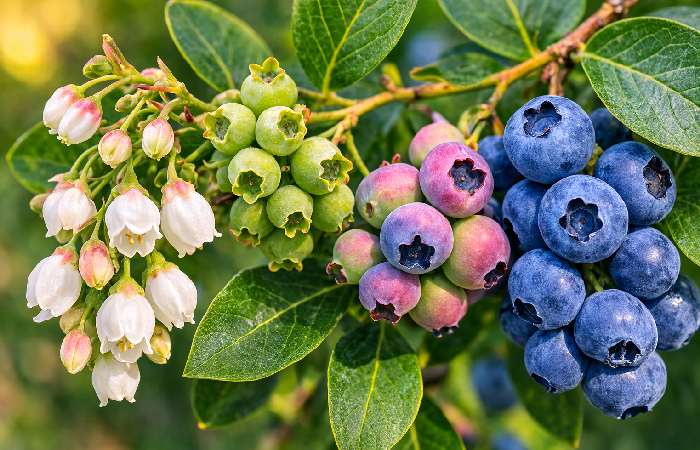
The Role of the Inferior Ovary
Knowledge about the development of blueberries explains why they are defined as berries.
The blueberry life cycle:
- Flowering stage — The plant produces small, white or pink, bell-shaped flowers
- Pollination — Bees transfer pollen to fertilize the ovary
- Fruit set — The fertilized ovary begins to swell
- Development — The ovary wall (pericarp) thickens and fills with sugars and water
- Ripening — Chlorophyll breaks down, revealing blue-purple anthocyanin pigments
- Maturity — The berry reaches full size with embedded seeds
Key point: The entire edible portion of the blueberry comes from the ovary wall. And such is the peculiarity of a real berry. The body that enclosed the seeds was an extension of the reproductive organ of the flower.
Blueberry Fruit Structure and Anatomy
Secting a blueberry in half you will be able to observe anatomical characteristics of a real berry:
External features:
- Skin (exocarp): Thin, waxy coating with protective bloom
- Crown (calyx): Remnant of the flower that is in the shape of a star.
Internal structure:
- Flesh (mesocarp and endocarp): Soft, juicy tissue packed with sugars and acids
- Seeds: Tiny (barely noticeable), dispersed throughout the flesh
- Locules: Cells in the fruit which had at first contained ovules.
The seeds are very tiny and you hardly notice when eating them–they are usually 20-30 seeds to the berry. Another characteristic of true berries is this multi-seeding of the interior.
Compare to non-berries:
- Strawberry: they have an outer coating of seeds (achenes); but flesh is not ovary, but receptacle.
- Raspberry: -Drupelets are distinct fruits, distinct ovaries.
Blueberry anatomy is obviously an appropriate fit of the berry blueprint.
Types of Blueberries and Their Classifications
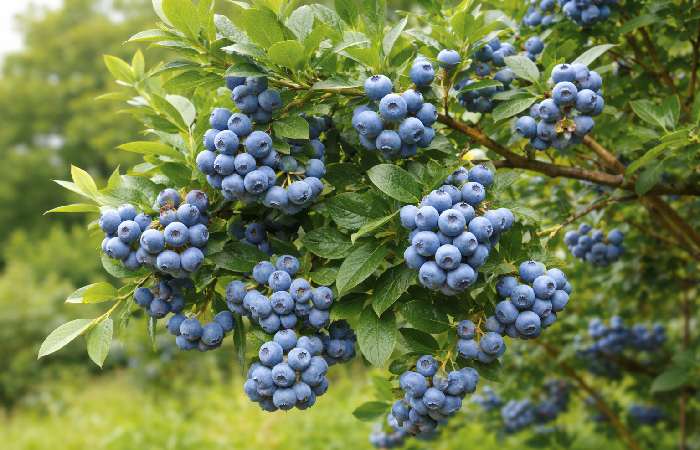
Not all blueberries are identical. There are a number of separate species and varieties, all of the genus Vaccinium.
| Type of Blueberry | Scientific Name | Plant Characteristics | Fruit Characteristics | Native Region / Notes |
| Highbush Blueberry | Vaccinium corymbosum | Tall shrubs, 1.5–3 m; cultivated commercially | Large, sweet berries; firm skin | Native to Eastern & North America; widely cultivated globally |
| Lowbush Blueberry | Vaccinium angustifolium | Low-growing, 15–60 cm; spreads via underground rhizomes | Small, highly flavorful berries; used for jams and frozen products | Native to northeastern North America; often wild-harvested |
| Half-High Blueberry | Hybrid of V. corymbosum × V. angustifolium | Medium shrubs; cold-hardy | Medium-sized berries; balance of sweetness and hardiness | Developed for cold climates; suitable for northern regions |
| Rabbiteye Blueberry | Vaccinium virgatum (syn. V. ashei) | Tall shrubs, up to 4 m; heat-tolerant | Medium to large berries; slightly firm | Native to Southeastern USA; thrives in warmer climates |
| Southern Highbush Blueberry | Hybrid (V. corymbosum × other species) | Medium shrubs; early fruiting | Sweet, large berries; adapted to mild winters | Developed for subtropical or mild climates; common in southern USA |
| Wild Blueberry | Various lowbush species (V. angustifolium, V. myrtilloides) | Naturally growing, low shrubs | Small, intensely flavored berries | Typically harvested in forests or wild fields; rich in antioxidants |
Cost of Blueberry
India
| Form / Product | Typical Price (INR) | Notes |
| Fresh blueberries – premium retail (per kg) | ~₹800 – ₹1,200/kg | Typical market retail range for premium imported fruit. |
| Fresh blueberries – supermarket punnet equivalent | ~₹240–₹320/kg (125 g pricing) | Available in smaller punnets; price varies by store and city. |
| Fresh blueberries – online pack (125 g) | ~₹209 per pack (≈₹1,672/kg equivalent) | Example offer from online retailer. |
| Fresh blueberries – smaller online deals | ~₹262 per 500 g (≈₹524/kg) | Promotional online price from some grocers. (jagsfresh.com) |
| Frozen blueberries – retail | ~₹581 – ₹726/kg | Frozen products generally cheaper per kg than fresh. |
| Dried blueberries – retail | ~₹1,025/kg | Dried berries are more concentrated and higher priced. |
China
| Category / Format | Typical Price (CNY) | Notes |
| Domestic freshly‑harvested blueberries (regular) | ~20–40 ¥ per kg | Wholesale/retail market rates when supply is high. |
| Domestic higher‑quality blueberries | ~60–80 ¥ per kg | Premium domestic varieties. |
| Supermarket retail – standard pack (~125 g) | ~16–20 ¥ per pack (~128–160 ¥/kg) | Reported average retail price.(m.guojiguoshu.com) |
| Very low‑price local fruit markets | ~15–30 ¥ per jin (~30–60 ¥/kg) | Market reports show prices dropping regionally. |
| Imported blueberries | Often higher than domestic | Imported fruit typically costs more due to shipping and tariffs. |
Uk
| Product / Pack Size | Typical Price (£) | Approx. Price per kg (£) |
| Fresh blueberries – Tesco 500 g | £4.55 | ~£9.10/kg |
| Fresh blueberries – Tesco 250 g | ~£2.60 | ~£10.40/kg |
| Fresh blueberries – Tesco 150 g | ~£2.00 | ~£13.33/kg |
| Fresh blueberries – Rosedene Farms 150 g | ~£1.30 | ~£8.67/kg |
| Fresh blueberries – Aldi (150 g) | ~£1.59 | ~£10.60/kg |
| Fresh blueberries – Aldi (300 g) | ~£2.55 | ~£8.50/kg |
| Fresh blueberries – ASDA mixed sizes | ~£2.68–£4.32 (250–500 g) | ~£5.36–£8.64/kg range |
| Frozen blueberries – Various supermarkets (350 g) | ~£2.12–£3.35 | ~£6.06–£9.57/kg |
Estimated Global Blueberry Market (2020–2026)
While exact annual historical data isn’t fully published year‑by‑year, we can use reported values for 2025 and 2026 along with reasonable estimates for earlier years to compute an approximate average value:
| Year | Estimated Market Value (USD) |
| 2020 | ~$7.0 B (estimated based on growth trend) |
| 2021 | ~$8.0 B (estimated) |
| 2022 | ~$9.0 B (estimated) |
| 2023 | ~$9.8 B (estimated) |
| 2024 | ~$10.0 B (estimated) |
| 2025 | $9.84 B (reported) |
| 2026 | $10.49 B (reported) |
Common Berry Misconceptions: What’s Actually a Berry?
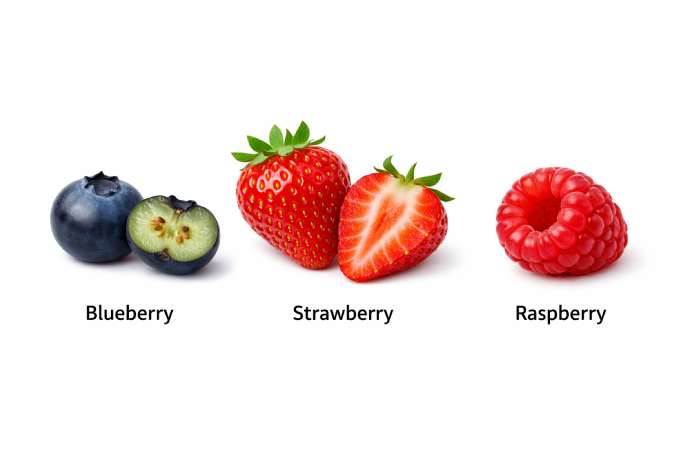
The difference between the ordinary names and the scientific naming causes confusion. Let us clarify on what are the most popular and what are not popular berries.
Why Strawberries Aren’t Berries
Strawberries are not berries they are accessory fruits.
Here’s why:
- The fruit has seeds (achenes) on its outside.
- The red meat you consume is the swollen vessel (the base of the flower), but not the ovary.
- Every minute grain is a fruit in itself.
Strawberries are botanically aggregates as accessory fruits. The flower contains several ovaries, although, the fleshy part is a growth of non-ovary tissue.
The irony: Although the name contains the word berry, the strawberries do not pass the botanical berry test that blueberries pass easily.
Why Bananas ARE Berries
Surprise: Bananas are true berries.
Bananas grow out of one ovary having three fused carpels. The whole fleshy interior is of ovary wall, and wild bananas have seeds (cultivated varieties sterile and undeveloped).
Banana berry credentials:
- ✅ Single ovary from one flower
- ✅ Fleshy pericarp
- ✅ Seeds embedded in flesh (in wild types)
- ✅ Meets all botanical berry criteria
Botanical cousins are bananas, blueberries and grapes, all of which, though so very different, are truly berries.
The Raspberry and Blackberry Exception
Raspberries and blackberries are aggregate fruits, not berries.
A raspberry or blackberry has one big fruit and then a thousand little ones almost the size of a period or a full-stop: a drupelet, or a miniature fruit of a different ovary. There are dozens of ovaries on a single raspberry flower and these produce one drupelet. They are united to make the familiar fruit.
Structure breakdown:
- One flower had several ovaries.
- The drupelets have one seed each.
- Technically, they are all small druplelets (microscopic cherries).
Contrast with blueberries:
- One ovary producing one fruit
- Multiple seeds within that single fruit
- Structure qualifies as a true berry
This difference is important in botanical classification, and is the reason why common names are misleading. (Vedantu)
Why Blueberry Classification Matters
Nutritional Implications
Blueberries have a nutritional profile that is affected by the berry structure.
Connection between nutrition and anatomy of the berry:
- Thin skin with high surface area → More antioxidant-rich pigments (anthocyanins)
- Multiple small seeds → Higher fiber content relative to fruit size
- Fleshy pericarp → Water content and vitamin C distribution
The classification of blueberries as epigynous berries implies that the parts which are eaten are made entirely of ovary tissue which concentrates:
- Antioxidants (particularly anthocyanins)
- Vitamin C
- Vitamin K
- Manganese
- Dietary fiber
A small package that enables easy storage of nutrients is the reason behind the superfood status of blueberries due to the berry structure.
Botanical and Agricultural Significance
Understanding blueberry classification helps:
Growers:
- Pollination requirements — Knowing flower structure guides bee management
- Cultivar selection — Understanding botanical relationships helps predict traits
- Soil chemistry — Ericaceae family needs acidic soil (pH 4.5–5.5)
Botanists:
- Evolutionary studies — Berry development reveals plant relationships
- Conservation efforts — Protecting wild Vaccinium species
- Breeding programs — Crossing compatible species within the genus
Consumers:
- Quality assessment — Understanding fruit structure helps identify freshness
- Nutritional knowledge — Recognizing why berries have specific health benefits
- Culinary applications — Berry structure influences cooking and preservation methods
It is not merely a kind of academic classification, and has practical implications in various fields. (Britannica)
Frequently Asked Questions About Blueberry Classification
Q: Are blueberries considered true berries?
Yes, blueberries are true berries. They grow out of one flower with single ovary, bear royally enclosed within fleshy tissue, and fulfil all botanical requirements to be classified as berries.
Q: What family do blueberries belong to?
Blueberries are in the family of the heath, which is generally referred to as Ericaceae. This family comprises of cranberries, azaleas, rhododendrons, and heathers.
Q: Why are strawberries not berries but blueberries are?
The strawberries are accessory fruits in which the fleshy part arises not of the ovary, but of the receptacle of the flower, and the seeds are external. Blueberries are botanical true berries because they grow out of the ovary and have seeds in them.
Q: What is the scientific name for blueberries?
The most common cultivated blueberry is Vaccinium corymbosum (highbush blueberry). Wild blueberries are Vaccinium angustifolium (lowbush blueberry). Both belong to the genus Vaccinium, section Cyanococcus.
Q: Are cranberries and blueberries related?
Yes, cranberries and blueberries are closely related. Both belong to the genus Vaccinium in the Ericaceae family, and both are true berries botanically.
Q: What makes a fruit a berry vs. a drupe?
There are several seeds inside of fleshy ovary tissue (blueberries, grapes). A drupe is a seed, which is contained in a hard stone or pit and wrapped in flesh (cherries, peaches).
Q: How many seeds does a blueberry have?
An average blueberry has 20-30 small seeds yet they are so minute that you hardly notice them as you eat.
Q: Are all berries in the same plant family?
No, the real berries are present in numerous families of plants. True berries and the family of Blueberries (Ericaceae), grapes (Vitaceae), tomatoes (Solanaceae), and bananas (Musaceae) belong to different families.
Conclusion: The Final Verdict on Blueberries
Blueberries are true berries—scientifically, botanically, and structurally.
They are members of the genus Vaccinium of the family Ericaceae, grow out of a solitary flower, which has an inferior ovary, and has more than one seed within it enwrapped in fleshy tissue formed by the ovary wall. This classification makes them to be under the same category with grapes, tomatoes and bananas as a legitimate botanical berry.
When the next person asks you whether blueberries are real berries you can be sure and explain that they are the most genuinely berry-like fruits in the world-far more so than strawberries or raspberries though they are called that way.
The reason why a blueberry is a berry adds value to the enjoyment of these beneficial, tasty fruits as well as the interesting reasoning methodology of botanical taxonomy.