
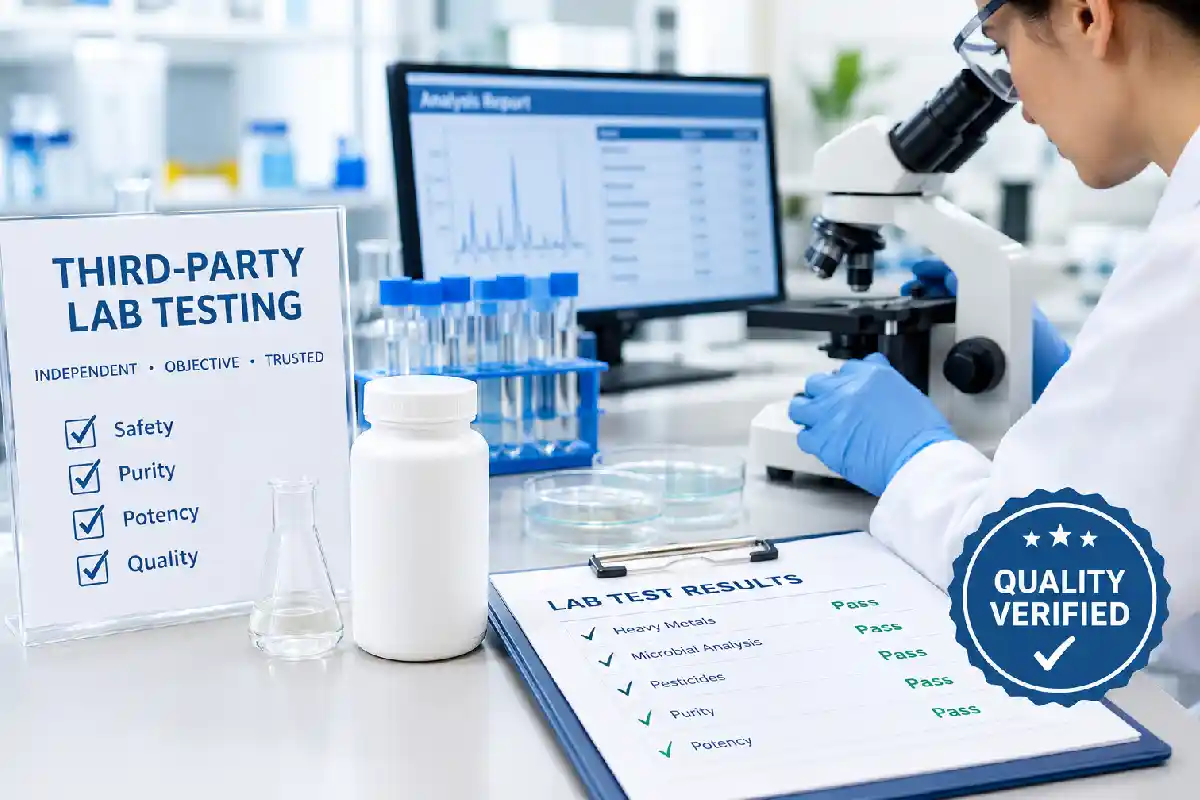



‘Premium.’ ‘Pure.’ ‘High-quality.’ These words appear on essentially every wellness product on the market. There’s no requirement to prove any of it. The words cost nothing. The photos of scientists looking purposefully into microscopes in pristine white labs are convincing and communicate exactly nothing about what’s in the vial. Marketing learned a long time ago that the appearance of rigor is nearly as persuasive as the actual thing.
Third-party testing is different. It tells the buyer something that can be verified. That’s the whole reason it matters.
Table of Contents
What Third-Party Testing Actually Is
An independent accredited laboratory with no financial relationship to the company tests the compound and reports what it found. Short version. The critical part is ‘no financial relationship.’ An independent lab has no incentive to produce a pleasing result. They test what they receive and report what they find.
Compare that to an internal quality assurance report, where the company decides what gets tested, how results are described, and whether they get shared at all. These are not equivalent documents. One of them has a potential conflict. The other doesn’t.
What a Certificate of Analysis Should Actually Cover
A legitimate certificate of analysis covers three things at minimum. Purity by HPLC, which tells you what percentage of the content is actually the compound on the label. Identity confirmation, which verifies it’s the right compound rather than something that looks similar on a chemical level. And contamination testing for heavy metals and microbial presence.
Some suppliers test one of these and present it as though all three are covered. A purity number with no identity confirmation and no contamination testing is not a clean bill of health. It’s a partial answer to a much larger question.
Why Batch-Specific Documentation Is the Standard
A certificate from a production batch two years ago is not documentation for the product currently in stock. Batch-specific documentation, tied to the exact lot number being shipped, updated with each production run, is what actual transparency looks like. The lot number should appear on both the product and the certificate, and they should match.
Suppliers who offer this before being asked are making a confident statement about what they’re selling. Suppliers who can’t produce, or produce certificates with no batch specificity, are making a different kind of statement.
Why This Matters in the Vitality Peptide Market
In the vitality peptide market, the gap between suppliers is real and almost completely invisible from the outside. Two products can share the exact same compound name, sit at nearly the same price point, and be fundamentally different things. Different purity. Different potency. Different safety profile. The label tells you almost nothing useful about any of that. The customer has no way to see that gap unless they’re looking at independent lab documentation.
Without it, the whole purchase rests on the assumption that the marketing is accurate. In this space, that is a very large assumption.
The Signal That Cuts Through Everything
When every brand calls itself premium, premium stops meaning anything. When price varies but documentation quality varies far more, price becomes the wrong filter. The signal that actually tells you something is documentation. Independent. Verified. Batch-specific. Recent. It doesn’t look great in an ad. It’s not designed for social media. It’s just the one piece of information that actually predicts whether the product is what the label says it is.
Take Away
Ask for the certificate of analysis before anything else. How the supplier responds to that request tells the buyer more about the company than the entire rest of their website.
Saba Mirza is a Health, Wellness & Lifestyle Writer at Being Healthy Life with 3+ years of writing experience. She creates clear, informative, and reader-focused content covering health, wellness, nutrition, fitness, natural health, and lifestyle topics.
View Profile →
Sameena Begum is a health, technology, and digital content reviewer who reviews selected articles to help ensure that information is presented clearly, accurately, and responsibly.
View Profile →
Dr. Syed Imtiaz is a qualified medical professional with MBBS and MD qualifications and 5+ years of experience. As a Medical Reviewer at Being Healthy Life, he reviews selected health and wellness content for medical accuracy, clarity, appropriate context, and responsible presentation.
View Profile →